Movie lovers, or more specifically, Stanley Kubrick aficionados, will already know which the movie the subtitle of this article alludes to. But it’s merely a tenuous segway in order to quote these words by the director of the famed Dr Strangelove:
“I like to read. Everything. Anything. I’ve come to realize that there’s so many books and so little time to read… you cannot possibly read enough.” (in conversation with Tim Cahil for Rolling Stone magazine, 1987)
What follows isn’t a movie analysis, although I do plan on writing about movies on other occasions. Rather, here I want to present some loose reflections on two significant parts of my life that, on the surface at least, are in conflict with each other: being dyslexic, and being a compulsive reader. Along the way I’ll also discuss my love of books in general and my personal approaches to the art of reading well. It takes me a lot of work to write anything, and this piece was no exception. Still, it was rewarding to do, and it’s been ages since I last wrote anything in an organised fashion. Apart from this being a transparently self-indulgent endeavour, I do hope it resonates with other people with dyslexia, or just encourages anyone to be a more attentive and deliberate reader. Below there should be something valuable for book lovers of all stripes.
As part of some research and development training for my job, I’m progressing through a course on working with individuals with learning disabilities. Given my dyslexia, this particular area happens to be of interest. The course is shedding a lot of light on some of my experiences growing up, and the way I process things day-to-day. This course is partly what prompted me to write on the subject.
I have always sought to be a decent reader. I hesitate to say I always love to read, because in practice it’s more often like a lover’s quarrel. Even so, I continually feel a nagging compulsion to read. Over the years, I have amassed a pretty substantial collection of books. Recently on Vinted, I sold over sixty books to create new shelf space (ironically for more books). Despite this, the inviting book-sized gaps, where the sold books once resided, were immediately filled by ones that were patiently waiting in the attic. Other books had until then been simply loitering around without a permanent home on the shelves. As ever, the bibliophile’s mountain seems to relentlessly grow at a rate faster than can be scaled. The voracious appetite of the reader does not so much as make a dent in the looming literary universe. I know the solution is to stop buying them, but let’s face it—that’s not going to happen.
For me, the compulsion to read can be so all-consuming that it can manifest as a haunting anxiety. To repeat Kubrick’s remarks “so many books and so little time…”. In a similar vein, philosopher Alain De Botton notes on X that:
“Some 130 million books have been published in history; a big reader will get through 6,000 in a lifetime. Choose carefully…”
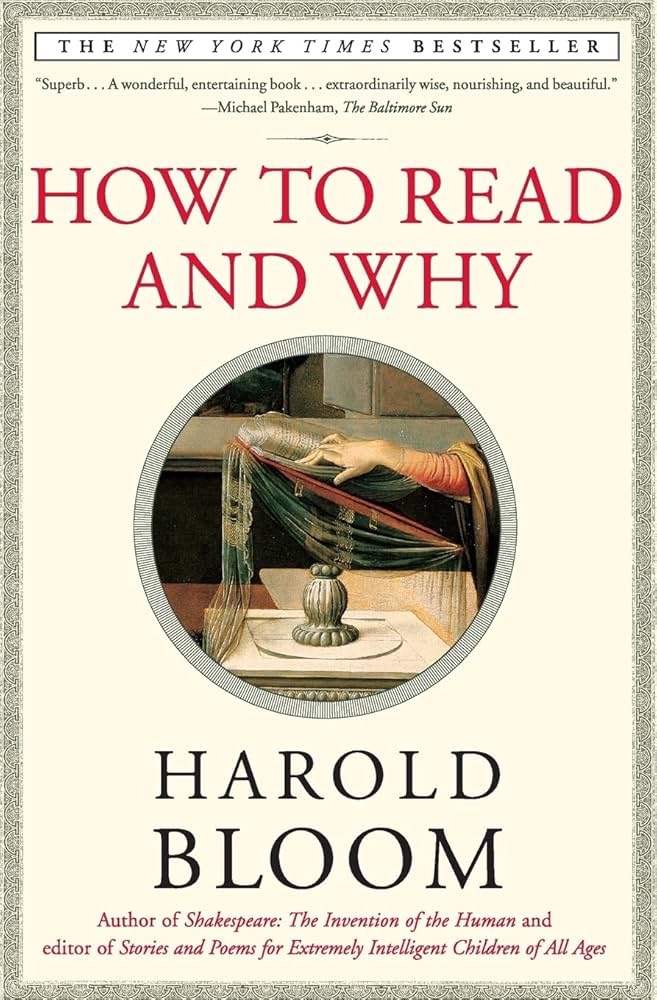
Despite the patently unrealistic figure of 6,000, the point stands. Digging the knife in further still, literary critic Harold Bloom notes in How to Read and Why:
You can read merely to pass the time, or you can read with an overt urgency, but eventually you will read against the clock.
On some days, the urgency I feel when thinking about how much there is to read, has a rallying effect and forces me to dive in, the only bad side-effect being crippling insomnia. I should add, however, that this nocturnal affliction, the resolute defiance against oblivion, is a lifelong malady that doesn’t require any further encouragement. On other days, at their most damaging, these panicked thoughts lead me to lapse into paralysis, and I give up.
As a slight aside, given the mind-boggling volume of books waiting to be feasted on, it seems fewer people are inclined to indulge these days. Unfortunately statistics suggest that the number of people reading books is steadily declining, particularly amongst males. It isn’t quite as depressing if people are turning to audiobooks or eBooks as an alternative (I make use of these mediums too). But fewer are reading anything remotely book related. Part of the blame lies with the consumption of short form content in the form of YouTube, social media, and all its dizzying incarnations, plus several other factors. Let’s help serve to reverse this trend.
Reading With Dyslexia
When it comes to the rituals of reading, everyone has their own system, whether by default or by design. But what’s it like reading with dyslexia? It’s been firmly established that dyslexia has a significant effect, but the impact varies from person to person. For me it affects my speed and accuracy a great deal. If I read naturally, words can be missed or misread, and as a result it distorts my comprehension. If I’m particularly tired, the words sometimes take on a life of their own, morphing into a formless mass of tangled syntax. It’s not that I experience letters and words literally dancing on the page, it’s more a case of the brain taking in only fragments of words and temporarily fusing them with parts of other words. A very confusing, albeit effective method for inventing new words unintentionally. Another issue is misreading similar-looking letters like b, d, p, and q. This can make reading often tiring, a little stressful, and causes a lot of eye strain.
Whereas I imagine the average reader’s eyes seamlessly gliding along page after page, there I sit halting, rereading, rearranging, and re-rereading every few sentences. This endless cycle of vexing interruptions is then followed by a pang of self-loathing towards my inability to tame the pirouetting prose. But by now I’m well accustomed to this routine. I slightly exaggerate here of course, and there are rare moments of lucidity when I inexplicably pass through a paragraph or two, from beginning to end, without stumbling. Such deviations from my default state are very welcome accidents.
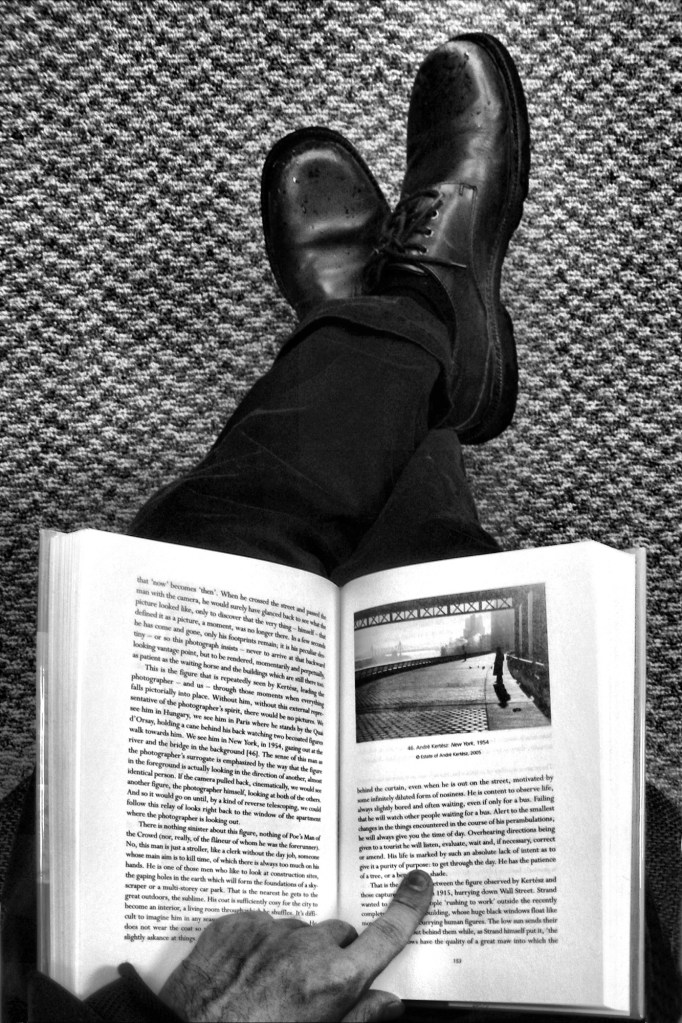
Throughout the years I’ve toyed with several methods for alleviating the problems outlined. Most of them are fairly obvious and prosaic. The first, and I believe most important line of defence, is to read s l o w l y! I simply take my time, and let my eyes move at a slower rate. This allows me to establish a rhythm and tempo that significantly reduces the likelihood of stumbling. In conjunction with this, my fingers follow the lines to keep my eyes from losing their grip on the text.
Beside the other obvious strategies, such as reading in a good light, in environments with minimal distractions, I also reread. By this I don’t mean merely sentences, paragraphs or pages, but actually rereading the entire book itself. I know this act isn’t alien to every regular reader. Revisiting a fine novel is primarily a repeated indulgence which can be freely enjoyed, and there is nothing ignoble about this. Just as a listener may wish to repeatedly soak in the sounds of a cherished song or piece of music, so may a reader wish to equivalently bathe again in literary pleasures, via the eyes and imagination. This may be in order to engage with the prose once more, and/or to experience the unique world and characters created by the author. If there is a significant gap between the first and the second engagement, there can still be that unexpected joy of being reminded of the intricacies, and half-remembered twists and turns of the plot. But it’s difficult to forget the contours of the more general story arc. Once a novel has been explored, the overall story, including the ending, is already known. That singular first encounter is unrepeatable, short of a bad memory lapse. Normally we don’t read a second time in order to find out what happens all over again.
What of the non-fiction reader? An individual can of course enjoy both fiction and non-fiction; in my view the best readers explore both worlds. Apart from the pure enjoyment of an artful writer’s prose, a second pass of a more information-rich book may be necessary to unearth its finer treasures. It’s impossible to take in everything needed in one hasty encounter. This is more of an imperative for those studying for academic purposes, where research needs to be more rigorous.
For myself, rereading is at first a necessity, rather than an option. But given a well chosen book, I can still enjoy that constrained choice. Whatever genre, I don’t feel I’ve truly read a book until it’s been wrestled with two or three times consecutively. This holds true for any and every book, sadly including the ones that don’t warrant admiration in the final analysis. For these reasons, in order to minimise wasted efforts, I must be extremely discerning in my choices (more on this later). There must be a pretty high prior probability of me enjoying it, or learning something worthwhile. Preferably both!
In wondering how much other readers revisit texts, I felt somewhat vindicated when I struck upon Vladimir Nabokov’s words, in his essay Good Readers and Good Writers. I quote at length, but his thoughts are well worth reflecting on:
“one cannot read a book: one can only reread it. A good reader, a major reader, an active and creative reader is a rereader. And I shall tell you why. When we read a book for the first time the very process of laboriously moving our eyes from left to right, line after line, page after page, this complicated physical work upon the book, the very process of learning in terms of space and time what the book is about, this stands between us and artistic appreciation. When we look at a painting we do no have to move our eyes in a special way even if, as in a book, the picture contains elements of depth and development. The element of time does not really enter in a first contact with a painting. In reading a book, we must have time to acquaint ourselves with it. We have no physical organ (as we have the eye in regard to a painting) that takes in the whole picture and can enjoy its details. But at a second, or third, or fourth reading we do, in a sense, behave towards a book as we do towards a painting.”
Memory and Retention
Beyond repetition, there are other notable particularities to my approach. One key outcome for me is always a high retention rate. I’ve often heard from other readers, that once the final page has been taken in, they have little memory of the details earlier on in the book. Some days later, when attention has been diverted to something new, the memory of the previous book increasingly fades. This is inevitable in many ways, but personally I like to be able to remember as much as possible long after the immediate experience. The same goes when trying to retain important information in non-fiction and academic works.
After much trial and error, I’ve found that the perfect way for me to achieve maximum retention is the simultaneous use of a physical copy, along with an audiobook. This may seem unusual and extreme, but it works well for me. It’s a thoroughly immersive experience and there’s something about the combination of sight and sound, eyes and ears, that helps attach the words to my memory. I then use various memory techniques, such as memory palaces, to retain the information long-term. There is, as it happens, a good deal of research out there on the benefit of this method, revealing it to be one of the most effective reading techniques.
Here then, is the complete routine. Once a book is settled on, I begin my long and turbulent ascent. I journey through the book once (with audio), without stopping to make notes or worrying much about full comprehension. I then reach for the scalpel (in the guise of a pencil), and start again, this time feeling at liberty to stop at any point to underline, highlight, and add marginalia. I know some people are averse to leaving marks in their books, but I believe books aren’t meant to be preserved as characterless, pristine museum artefacts. One should interact with them as if they were a dynamic dialogue partner. If the item at hand is a novel, I would most likely give it a third go, but this time in a manner more like the first reading. I do it with as little interruption as possible, and enjoy it in a more holistic, non-analytical manner. If a non-fiction text were being examined, particularly of a heavy, academic variety, I revisit each chapter and tabulate the key arguments and vital insights in a notebook and file them away. These notes can then be referred back to at leisure. Using this routine, with each additional read I invariably find that any missed details and comprehension gaps are satisfyingly resolved.
As you can imagine, the downside to all of this, is that it’s more time consuming and I don’t get through as many books as the average reader. But this fact no longer bothers me and I’ve learned to stop worrying about arbitrary numerical conquests. I feel content knowing I thoroughly understand and remember what I read. It’s about learning to enjoy the slow and deliberate process, and revelling in the pleasures and insights under my nose. I’ve made peace with knowing that however much time I have, I’ll still wish I had read countless more books. Even the swiftest bookworm will wish they had more time, so it’s pointless worrying. It’s enough to be thankful that we have the opportunity to experience any great literary work, piece of art, or music.
On Choosing Well
How do I choose what to spend time on? No one’s reading choices are completely disconnected from trends and social pressures. But we shouldn’t read “just because” this or that person/group insisted. Few things could be worse than engaging in performative ‘lit bro’ pretensions, and finding yourself trawling through a David Foster Wallace or Cormac McCarthy novel for no reason. I’m not saying these aren’t worthwhile authors to explore, but the intention behind choosing them needs to be genuine. At the end of the day, noboby really cares what you read, or how many books you read, and no one is vetting your list of consumed titles, unless you hang around with obnoxious ideologues. Let your natural interests drive you, consider a recommendation from a trusted friend, or just stick with what you like. On the one hand, it’s important to occasionally take a risk and try something out of left field; new books and authors need to be experienced. On the other hand, there’s also nothing wrong with, for a time, sticking with a trusted author who has earned the right to be revisited.
As I get older, my taste have widens. In the past my reading was predominantly as a means to an end. The aim was always to acquire some new knowledge rather than for pure enjoyment. Around 85% of my reading material would have been non-fiction. Subject-wise I often go for music, philosophy, science, theology, and history. However, these days I’m much more inclined to include more fiction in my reading choices, and will happily indulge in an artfully written story. I try to read very widely, although I still have favourite subjects that I delve deeply into, when time permits.
Despite the challenges of reading with dyslexia, I have never felt the need to give up. I continue because I still love it. I realise my description of the painstaking process I go through doesn’t sound particularly fun. But there is something endlessly satisfying about meeting the challenges and working through them. After completing a particularly great book, I have little recollection of the toils along the way, and am left only with the pleasure of having imbibed the work as a whole.
I don’t expect that anybody will be persuaded to adopt any of my idiosyncratic methods. Do what works for you. But if you experiment, you may be surprised at what you discover. This holds true for those with or without learning difficulties. If there’s anything to take away from what I’ve written, it would be simply to keep reading. But read deeply, widely, and enjoy it, even if it’s a bloody struggle.
 The Balance of Reason